Under Sink Water Filter

The water filtration market can be difficult to navigate. Which one is best? What do I need it to do? What is structured water? What is ionised water? Will a water ioniser filter the water? Will a water filter ionise the water too?

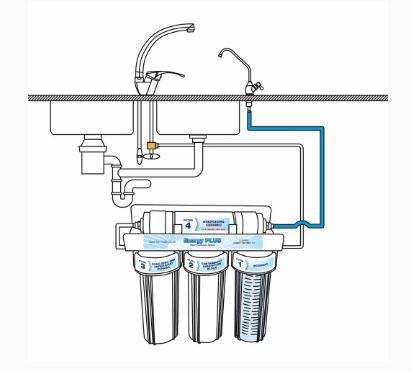
Water filter fitted beneath the sink to connect to a dedicated drinking tap.

After a lot of research on the internet and discussion with industry experts, I have come to the conclusion that the Energy Plus Undersink Water System from Water For Health is the best system which brings the best of both filtered and ionised water, ensures that the water is structured for the highest bio-availability, is affordable in price, easy to install, and has great personal, knowledgeable customer service.

I have been using this system since 2021 and replace the filter cartridges myself annually.

The water passes through 4 filters before coming through your tap:

Filter 1: An ultrafiltration membrane filter cartridge to remove particulate and act as a barrier to bacteria and cysts. It filters down to 0.1 micron, so removing most particulate including microplastics.

Filter 2: An advanced carbon block filter using minerals and polymers to give extremely efficient removal of heavy metalschlorinefluoridepesticideshormones and pharmaceutical resides.

Filter 3: This filter uses a combination of several types of bioceramic minerals including tourmaline, to improve water structure and its beneficial mineral content.

Filter 4: This filter uses a combination of bioceramic filter media to increase the alkalinity of the water and give it antioxidant properties through the release of molecular hydrogen. It also uses granular activated carbon for final filtration of the water.

For more information check out my affiliate link or order directly from me here.

Water and hydration are at the centre of health.

Thoughts on Sleep

Woman sleeping peacefully.

Aside from nutrition, getting good quality sleep is probably the most important aspect for health and longevity. It is the cornerstone to good health,vitality, living longer and feeling well.

As basic as it sounds, we are designed to live with the diurnal rhythm; we wake with the light, and we sleep in the dark.

From around 5-6pm in the evening, our cortisol levels naturally start to drop, and the natural light starts to dim, and melatonin levels begin to rise. Melatonin is the hormone that makes us feel drowsy and gets us ready for a good night’s sleep.

I love to look at the Yin/Yang aspect of everything, and we can see here we have the dark night time which is Yin, and the light daytime which is Yang. We can also see that cortisol is the Yang to it’s counterpart melatonin, which is Yin. Our Yin and Yang aspects are always ebbing and flowing gently, gradually and naturally. Therefore its a really good idea to get into a winding down routine in the evening to allow our Yin to naturally deepen and do its work for a good night’s rest.

Its a great idea to adjust your daily activities (as much as is possible) to support this natural daily rhythm. Eating breakfast and your main meal, taking physical exercise and doing the main bulk of your work during the morning and earlier part of the day is best as this is when cortisol is at its highest.

As cortisol starts to drop early evening, its better to eat a smaller evening meal at least 3-4 hours before bedtime. The ‘321’ idea is an easy concept to follow:

  • Eat no later than 3 hours before bed
  • Drink no later than 2 hours before bed (any fluids)
  • No screens no later than 1 hour before bed.

If you can’t switch off your mind, meditation is helpful, as is Valerian, chamomile and magnesium. A bath with Epsom salts will give you a great boost of magnesium, and as your body temperature starts to drop afterwards, it will naturally help to make you feel sleepy. A cup of night time tea might also be useful. Try different things and see what helps you – we are all different!

We should be getting around 90 minutes of deep sleep every night and this usually happens earlier into the night. Its during the deep sleep where our body replenishes, heals and rejuvenates.

We should be getting around 2-3 hours of REM sleep a bit later on in the night, after deep sleep, and this is the type of sleep where our mind sifts, sorts through and processes everything that’s happened during the day. I believe this is why meditation can be so useful because sitting quietly and observing our thoughts for a few minutes before bed will get ahead of the sifting and sorting process that happens during REM.

We can disrupt our deep sleep by exercising too much. It’s a bit like taking a car on a very long drive; the engine will have been revved up and used a lot of oil. It will take longer to cool down and get back to normal. It’s the same with our body and mind. It can leave you wired even if you have done a lot and think you should be tired.

If you are a snorer then this will disrupt your sleep patterns, particularly if it causes apnea and wakes you everytime you’re snoring too loudly or gasping for air. It also means that you are not breathing through your nose as much. Nasal breathing increases the gas nitric oxide which is a molecule produced naturally in the body and is important for relaxing blood vessels and allowing them to widen and increase circulation (and so increasing oxygen and nutrient circulation around the body). It also helps us to feel relaxed and switch from ‘fight or flight’ to ‘rest and digest’ i.e. switching off the sympathetic nervous system and switching on the parasympathetic nervous system. Again these are the Yin and Yang aspects of health. Nasal breathing helps us to move out of Yang and into Yin.

Humming on the outbreath creates vibration which will open up the airways and increase nitric oxide, again making us feel relaxed and able to sleep better. So do some “Oms” with your evening meditation and see if you notice the difference!

Going back to snoring; snoring is usually down to raised inflammation making the airways swollen and restricted. Reducing inflammation is something to really work on if you are a snorer; losing weight, eating the rainbow, cutting down on refined carbs and sugars, processed foods, alcohol, smoking, caffeine, upping your omega 3s by eating oily fish, nuts and seeds, olive oil etc.

Working with a practitioner like myself with regular reflexology and/or acupuncture can be so useful in taking care of your overall health and wellbeing, and we can usually pinpoint areas that might be disturbing your ability to get a good night’s sleep.

Overall, getting into good habits by creating a bedtime routine or ritual that you follow each night, tailored particularly to those things that work for you, is the best way to set the stage for a good night’s sleep.

If you are interested in working with me please get in touch.

Links to carefully selected affiliates.

Salts explained

Salt with a wooden spoon.

Sea salt is really good for soaking in a bath. It is believed to stimulate circulation, help ease muscle cramps, help relieve stiff joints, and soothe the skin.

Sea salt isn’t generally processed that much, it is simply evaporated off the water. So its very rich in trace minerals such as calcium, potassium, magnesium, zinc and iron.

Himalayan salts are very similar to sea salt in composition and trace minerals. However, because Himalayan salt is mined near the foothills of the Himalayan mountains, from some really ancient sea beds which were covered over with ice, lava and snow for millions of years, its thought that Himalayan salts are much purer than our regular sea salt because they are not full of our modern day pollutants.

Epsom salts aren’t actually a salt. They are magnesium, sulphur and oxygen. So when you use Epsom salts you are really using them for their magnesium content. Magnesium is needed in the body for all sorts of daily functions at a cellular level, and it is thought that in this day and age we are all lacking in magnesium due to the erosion of soil quality. Magnesium is very easily absorbed through the skin so soaking in a bath of Epsom salts is a great way to boost your magnesium levels.

Although we do need magnesium to support a whole host of bodily functions, one of the main things we all need it for is stress-management and improved sleep.

So these are the different types of salt explained, so you can now make an informed choice as to which type you would like to bathe in. Happy soaking!

View the bath salts from Neal’s Yard Remedies Organic.

Look after your DNA with good nutrition

Did you know that 99.9% of all our genetic material is identical in humans, which is what identifies us as a species? The 0.1% of our genetic material is different from person to person and  is what makes each person unique (causing differences in things like hair and eye colour, height and nutrition needs). These differences between people are called gene variations or polymorphisms. [1] Some gene variations may cause rare diseases (and are often referred to as mutations), while others are more common (and are just described as polymorphisms). Gene mutations and polymorphisms may interact with other genes and with factors in our environment (including diet, smoking, physical activity etc), to play a role in the development of complex disease such as Type 2 diabetes, asthma, cardiovascular disease. [1]

So it is really important that we do everything we can to look after our DNA. This is particularly important for sperm health, as they are literally a little head of DNA with a tail. So if you are trying to conceive, this is great advice.

There are three main ways to look after our DNA with good nutrition:

Preventing DNA damage. We should do everything we can to try to prevent DNA damage occuring because genetic mutations can lead to serious illnesses including chronic disease and some cancers.

To help prevent DNA damage from occurring ensure your diet is rich in nutrients, such as carotenoids (orange, yellow, and red foods, and dark green leafy vegetables), and foods rich in vitamin E (seeds, nuts, avocado).

DNA synthesis. In order to help our bodies synthesise or make DNA, we need foods rich in nutrients such as folate (vitamin B9) found in dark green leafy vegetables, pulses and legumes. A number of fruits are a great source of folate too, oranges being the highest but also look at grapes, grapefruits, banana and strawberries.

Other nutrients needed for DNA synthesis are vitamin B12, zinc and magnesium. If you’re a vegan then getting B12 into your diet through food alone is going to be a challenge so a supplement of at least 10 micrograms daily is recommended because Vitamin B12 is usually found in animal products. [2]

Superfoods spirulina and chia seeds are rich in magnesium; chia also being rich in zinc, iron, calcium and niacin (see below).

DNA repair is a very important: the body has the ability to repair areas, or mutations, that may have occurred due to DNA damage.  Key supporting nutrients that can assist with DNA repair are vitamin B3, or niacin, (peanuts, sunflower seeds, mushrooms), and folate (vitamin B9).

Chlorella is the fastest growing food on the planet, so eating it dramatically increases our rate of tissue repair and renewal, helping restore the nervous system, boost immunity and potentially helping degenerative disorders.[3]

It’s important to remember that it’s not just about the nutrients in isolation: so just taking a supplement of some of these key nutrients may not provide the same benefits as eating foods rich in these nutrients. There are so many other properties of foods, such as our bioactive molecules, antioxidants and polyphenols, and fibre, which also provide an important synergistic benefit. [1]

My personal recommendation would be to add a general multi mineral and vitamin supplement on top of a well balanced diet in order to ensure you are getting all the nutrients your body needs. Organic foods are best as they will be more nutrient dense, however our soils are so depleted nowadays that we need to supplement in order to ensure we put enough into our bodies through our diet.

I personally use chlorella powder blended with orange juice, avocado, kale and spinach every morning, sprinkled with chia seeds and nuts. I know that I’m nourishing my DNA and it gives me a great start to the day!

[1] Monash University https://www.futurelearn.com/courses/food-as-medicine/1/steps/77475

[2] Vegan Society https://www.vegansociety.com/resources/nutrition-and-health/vitamins-minerals-and-nutrients/vitamin-b12-your-key-facts

[3] Little book of superfoods by Tipper Lewis

Image courtesy of samarttiw at FreeDigitalPhotos.net

Jackie Marsden MAR is a qualified reflexologist, acupuncturist and independent consultant (Group Leader) for Neal’s Yard Remedies Organic. Jackie leads and mentors a growing team of consultants (many of whom are therapists integrating organic products into their existing businesses) via the NYRO social selling channel, holding regular team meetings, one-to-one coaching via phone and facetime, and a closed facebook group. All views are my own.

Growyourbusiness